Basement Waterproofing Paint and Basement Wall Paint Guide
Basement Waterproofing Paint and Basement Wall Paint Guide
Basement walls and floors are often exposed to moisture from soil, groundwater, humidity, condensation, plumbing leaks, and poor exterior drainage. When that moisture reaches the interior, it can lead to stains, peeling paint, musty odors, mold, damaged flooring, and long-term concrete deterioration.
A basement waterproofing paint can help protect certain concrete and masonry surfaces. However, paint is not the right solution for every basement water problem.
Some products are designed to reduce light moisture and improve appearance. Others are thicker waterproofing coatings made to resist water passing through concrete or block. A basement wall paint may brighten a room but offer little protection against groundwater. A true waterproof basement paint may perform better, but even that can fail if the wall has active leaks, structural cracks, or heavy hydrostatic pressure.
Choosing the right basement coating starts with identifying the source of the water and understanding what the product is designed to do.
Rebotec USA provides mineral-based waterproofing products for concrete and mortar used in residential, commercial, and industrial projects. For help choosing a basement wall coating or waterproofing product, call Rebotec USA at +1 469-352-3379.
What Is Basement Waterproofing Paint?
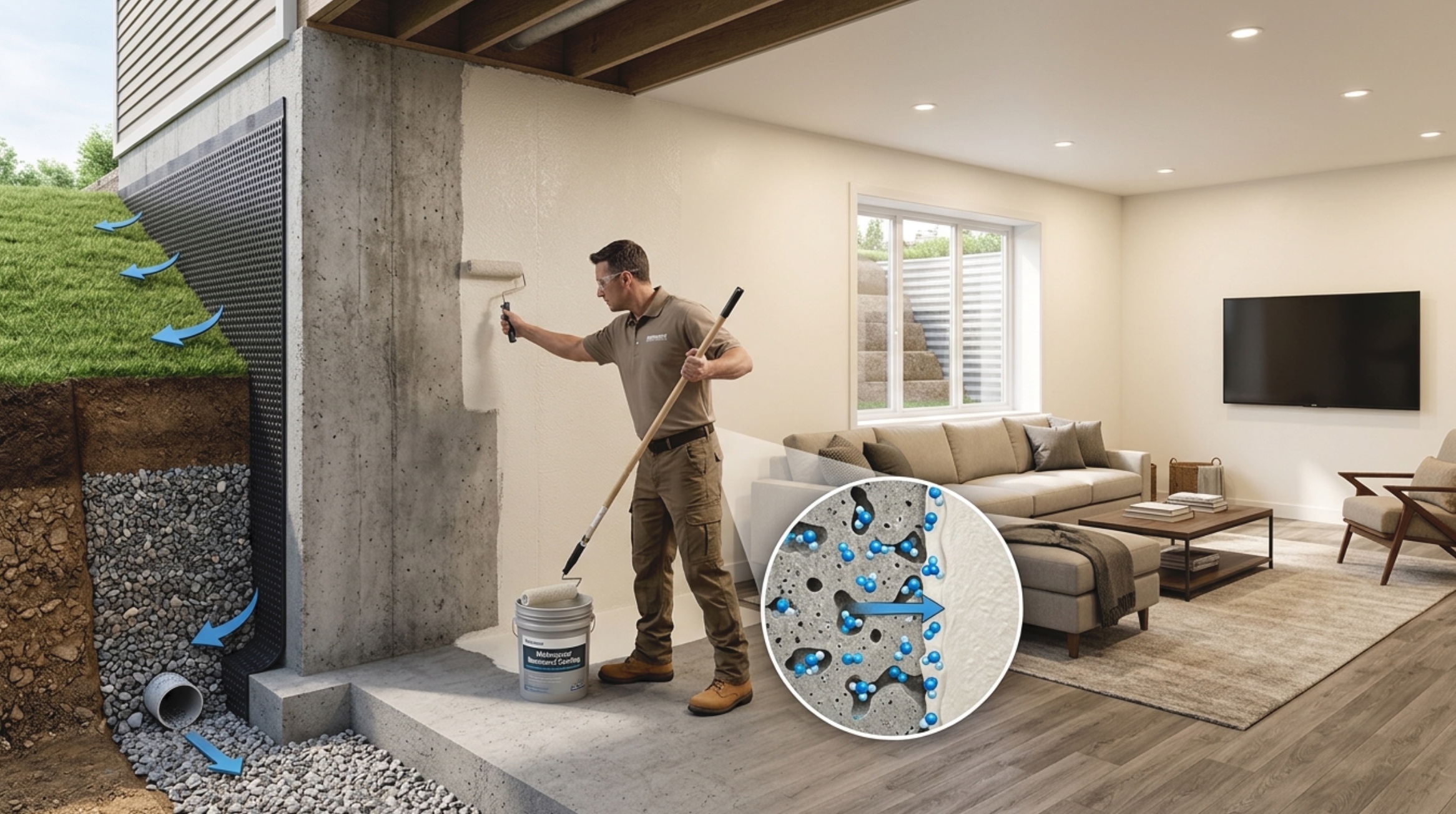
Basement waterproofing paint is a coating applied to concrete, masonry, or block surfaces to reduce water penetration and protect the surface from moisture.
Depending on the product, it may:
- Fill small surface pores
- Reduce water absorption
- Create a moisture-resistant barrier
- Improve the appearance of the wall
- Reduce surface staining
- Help control light dampness
- Prepare the wall for a finished basement
A waterproof paint for basement surfaces may be used on:
- Poured concrete walls
- Concrete block walls
- Cinder block walls
- Masonry walls
- Basement floors
- Utility rooms
- Crawl-space walls
- Interior foundation walls
The word “waterproof” should not be treated as a guarantee that the product can stop every leak. Some products resist occasional moisture. Others are designed to handle negative-side water pressure, which means water pressing through the wall from the exterior.
Always check the product’s intended use and limitations.
Basement Paint vs Waterproof Basement Paint
Ordinary basement paint is mainly decorative. It changes the color of the surface and may make the room easier to clean.
Waterproof basement paint is designed to provide more moisture resistance.
Standard Basement Paint
Standard basement paint may offer:
- Color
- A cleaner appearance
- Light stain resistance
- Easier maintenance
- Basic surface protection
However, it may peel, bubble, or blister when water moves through the wall.
Waterproof Basement Paint
Waterproof basement paint may offer:
- Better water resistance
- A thicker surface barrier
- Better adhesion to masonry
- Resistance to light negative-side pressure
- Mold- or mildew-resistant properties in some products
The best waterproof basement paint still depends on the wall condition, water source, and pressure. Paint cannot correct poor drainage, large cracks, failed joints, or structural movement.
Why Basement Wall Paint Peels
Peeling basement wall paint is usually a symptom, not the original problem.
Common causes include:
- Moisture moving through the wall
- Efflorescence
- Dirty or dusty concrete
- Loose previous paint
- High humidity
- Active leaks
- Poor surface preparation
- Applying paint to damp concrete
- Using the wrong primer
- Incompatible old coatings
- Hydrostatic pressure
Efflorescence is the white, powdery material often found on basement walls. It develops when water moves through masonry, carries salts to the surface, and then evaporates.
Painting directly over efflorescence usually leads to poor adhesion. The moisture source and loose deposits should be addressed before repainting.
What Kind of Paint Is Best for Basement Walls?
The answer to “What kind of paint for basement walls?” depends on the material and moisture conditions.
Common options include:
- Masonry paint
- Acrylic concrete paint
- Cementitious waterproofing coating
- Mineral-based paint
- Elastomeric coating
- Basement sealer paint
- Epoxy coating
- Rubberized coating
A dry, finished basement may only need a suitable masonry or concrete wall paint. A damp basement wall may need a waterproofing basement paint rated for moisture exposure. A wall with active water pressure may need drainage, exterior waterproofing, crack repair, or a full negative-side waterproofing system.
The best basement wall paint is not simply the product with the strongest waterproofing language. It is the product that matches the actual conditions.
Waterproof Paint for Concrete Basement Walls
Poured concrete basement walls contain pores and capillaries that can allow water vapor or liquid moisture to pass through.
The best waterproof paint for concrete basement walls should be compatible with concrete and designed for the direction of water pressure.
Before painting concrete walls:
- Check for cracks
- Look for active water
- Remove loose paint
- Remove efflorescence
- Clean dirt and dust
- Repair damaged concrete
- Test the surface for moisture
- Confirm whether the product requires a dry or damp substrate
- Follow temperature and ventilation requirements
A concrete basement wall paint may perform well on a stable, properly prepared wall. It is less likely to succeed when groundwater is actively pushing through untreated cracks or joints.
Waterproof Paint for Cinder Block Basement Walls
Cinder block and concrete block walls can be more difficult to waterproof than poured concrete.
Block walls contain:
- Mortar joints
- Hollow cells
- Multiple connected pores
- Horizontal and vertical pathways
- Potential reinforcement
- Surface texture
Water may enter the exterior side, collect inside the wall, and appear somewhere else on the interior.
A waterproof paint for cinder block basement walls can help protect the inside surface, but it may not stop water stored within the block.
Concrete block basement waterproofing may also require:
- Mortar-joint repair
- Exterior drainage
- Exterior membrane
- Sealed penetrations
- Interior drainage system
- Sump pump
- Crack repair
- Drainage panels
The wall should be inspected as a system rather than treated as a flat painted surface.
Masonry Paint for Basement Walls
Masonry paint is formulated for concrete, brick, block, stucco, and similar materials.
It can be useful because it is designed to bond to porous mineral surfaces. However, masonry paint products vary widely.
Some are decorative. Others are designed as waterproofing coatings.
Before choosing masonry paint for basement walls, check:
- Interior or exterior rating
- Concrete and block compatibility
- Water-pressure rating
- Required primer
- Breathability
- Mildew resistance
- Coverage rate
- Drying and curing time
- Recoat requirements
- Whether old paint must be removed
A breathable coating may allow water vapor to escape. A less permeable coating may form a stronger barrier but can be more vulnerable if pressure builds behind it.
Basement Wall Paint and Sealer
A basement wall paint sealer combines color with surface protection. It may be marketed as basement sealer paint, basement paint sealer, or basement wall sealer paint.
These products can be useful when the goal is to:
- Improve appearance
- Reduce surface dust
- Limit light moisture
- Cover stains
- Seal porous masonry
- Create a washable surface
However, a combined concrete paint and sealer product may not be equivalent to a professional waterproofing membrane or cementitious coating.
Read the technical instructions rather than relying only on product names.
Basement Waterproofing Coatings
A basement coating can be more substantial than ordinary paint.
Common coating types include:
Cementitious Coatings
Cementitious coatings are made from cement-based materials and additives. They bond well to concrete and masonry.
They may be used on:
- Basement walls
- Foundations
- Concrete block
- Water tanks
- Interior negative-side surfaces
- Concrete repairs
Some products are rigid. Others contain polymers for additional flexibility.
Mineral-Based Coatings
Mineral-based coatings are designed for compatibility with concrete and masonry.
Rebotec Paint is a mineral-based, hydrophobic waterproofing product made for concrete applications. It can help protect concrete surfaces while supporting long-term durability.
Project conditions should be reviewed before using any coating for active leaks, continuous submersion, or heavy water pressure.
Elastomeric Coatings
Elastomeric products form a flexible layer that can bridge very small surface cracks.
They are often used on:
- Exterior foundation walls
- Above-grade masonry
- Concrete walls
- Stucco
- Commercial exterior surfaces
Not all elastomeric products are intended for interior basement walls or negative-side pressure.
Rubberized Coatings
Rubber paint for basement walls and liquid rubber products create a flexible, water-resistant layer.
They may be used as:
- Exterior foundation coatings
- Below-grade membranes
- Interior specialty coatings
- Crack-bridging systems
The phrase liquid rubber foundation sealant/basement coating may describe several different product chemistries. Some are intended for exterior positive-side use only. Others may be approved for interior use.
A rubberized product should be selected based on its technical performance rather than its name or texture.
Foundation Sealant and Basement Coating
A foundation sealant basement coating is normally intended to protect foundation surfaces from moisture.
Exterior products may include:
- Rubberized asphalt
- Liquid membrane
- Sheet membrane
- Cementitious coating
- Elastomeric coating
- Drainage board
- Protection board
Exterior positive-side waterproofing stops water before it enters the foundation wall. It is often more complete than applying paint from inside.
However, exterior work may require excavation and can be difficult around driveways, patios, utilities, landscaping, and nearby buildings.
Interior coatings may be practical when exterior access is unavailable, but the product must be designed for the direction of water pressure.
Waterproof Paint for Basement Floors
A waterproof paint for concrete basement floor surfaces must handle different conditions than wall paint.
Basement floors may experience:
- Moisture vapor from below
- Groundwater pressure
- Foot traffic
- Storage
- Cleaning
- Furniture
- Finished flooring
- Temperature changes
Waterproof paint for basement floors may include acrylic coatings, epoxy, polyurethane, mineral-based products, or cementitious systems.
Before painting a basement floor, determine whether moisture is moving through the slab. If water vapor is coming from below, a non-breathable coating may blister or lose adhesion.
Floor moisture testing may be needed before applying epoxy, installing flooring, or using another low-permeability finish.
The best paint for basement floors should be rated for:
- Floor traffic
- Concrete adhesion
- Moisture conditions
- Slip resistance
- Intended cleaning
- Future flooring
- Indoor use
Wall paint should not be used on a floor unless the manufacturer specifically approves it.
Can Paint Prevent Mold in a Basement?
Mold-resistant paint for basement walls may contain ingredients that help resist mold or mildew growth on the painted surface.
It can be helpful, but paint does not remove the conditions that cause mold.
Mold needs moisture. To reduce mold risk, address:
- Water leaks
- Groundwater
- Condensation
- High humidity
- Poor ventilation
- Damp building materials
- Wet drywall or insulation
- Sump-pump problems
The best paint for basement walls to prevent mold is one designed for the surface and environment, but moisture control remains the most important step.
Existing mold may require proper cleaning or professional remediation before painting.
Paint-On Waterproofing: What It Can and Cannot Do
Paint on waterproofing is attractive because it seems simple. Clean the wall, apply a few coats, and stop the water.
In the right situation, it can work well. But it has limits.
Paint-On Waterproofing May Help With:
- Porous concrete
- Light dampness
- Surface water resistance
- Humidity exposure
- Minor moisture movement
- Improving the wall’s appearance
- Protecting stable masonry
Paint-On Waterproofing May Not Solve:
- Active leaks
- Structural cracks
- Failed construction joints
- Water entering around pipes
- Severe hydrostatic pressure
- Poor exterior drainage
- Water beneath a slab
- Broken plumbing
- Foundation movement
The visible wet spot may be several feet away from the real water-entry point.
Best Basement Paint for Walls Already Painted
Choosing the best paint for basement walls already painted requires evaluating the existing coating.
Before repainting, determine:
- Is the old paint peeling?
- Is there moisture behind it?
- Is the coating chalky or weak?
- Is there mold?
- Is efflorescence present?
- Is the old product compatible?
- Is the wall concrete, block, brick, or another material?
Loose paint should be removed. Painting over a failed coating simply attaches the new paint to a weak layer.
If the existing coating is sound, clean, dry, and compatible, it may be possible to repaint after proper preparation.
When the existing product is unknown, test a small area or follow the new coating manufacturer’s recommendations.
How to Prepare Basement Walls for Paint
Preparation often determines whether a basement coating lasts.
A general process includes:
- Identify the moisture source.
- Correct drainage, gutter, or plumbing problems.
- Remove loose paint and weak material.
- Clean mold and mildew safely.
- Remove dirt, dust, and efflorescence.
- Repair cracks, joints, and holes.
- Allow the surface to meet the product’s moisture requirements.
- Apply primer if specified.
- Mix the coating thoroughly.
- Apply the recommended number of coats.
- Maintain the required thickness.
- Allow full curing before adding finishes.
Do not paint over running water or an active leak unless the product is specifically designed for that condition and applied according to its instructions.
How to Choose the Best Waterproof Basement Paint
Before choosing the best waterproof paint for basement walls, ask:
- Is the wall poured concrete or block?
- Is the moisture light dampness or active water?
- Does the water come through the wall, floor, crack, or joint?
- Is the surface already painted?
- Is hydrostatic pressure present?
- Does the product work from the negative side?
- Is the wall stable or moving?
- Will the area be finished later?
- Is color important?
- Is mold resistance needed?
- What surface preparation is required?
- How long must the coating cure?
The best basement waterproofing paint is the one that matches the actual substrate and exposure.
When Paint Is Not Enough
Basement paint may not be enough when there is:
- Standing water
- Repeated flooding
- Active crack leakage
- Water at the wall-to-floor joint
- Heavy efflorescence
- Bowing walls
- Structural movement
- High groundwater
- A failed sump pump
- Poor exterior grading
- Damaged foundation drainage
Possible additional solutions include:
- Exterior excavation and membrane
- Interior perimeter drain
- Sump pump
- Crack injection
- Joint sealant
- Drainage mat
- Integral waterproofing in new concrete
- Structural repair
- Dehumidification
A full basement system may use paint or coating as one part of the solution.
Basement Paint vs Integral Concrete Waterproofing
Basement waterproofing paint is applied to an existing surface. Integral waterproofing is mixed into concrete or mortar before placement.
Basement Paint
- Works on existing concrete or masonry
- Can add color
- Creates surface protection
- Depends on adhesion
- May need future recoating
- Can fail if pressure builds behind it
Integral Waterproofing
- Is added during mixing
- Becomes part of the concrete or mortar
- Helps reduce water movement throughout the material
- Is best suited to new construction or new repair material
- Does not depend on a separate painted film
- Does not replace drainage, crack repair, or joint treatment
Rebotec Admix Powder is designed to create hydrophobic properties inside concrete or mortar. Rebotec Paint provides a surface-applied mineral-based option for appropriate concrete waterproofing applications.
Get Help Choosing a Basement Waterproofing Product
Basement products should be selected based on the wall, water source, pressure, and project goals.
Rebotec USA helps contractors, builders, distributors, and property owners evaluate mineral-based waterproofing products for concrete and mortar.
Call Rebotec USA at +1 469-352-3379 for product guidance and help choosing a basement coating, concrete waterproofing product, or long-term moisture-protection solution.
Conclusion
Basement waterproofing paint can help protect concrete and masonry walls from light moisture, water absorption, and surface deterioration. It can also improve the appearance of an unfinished basement.
However, paint is not a complete fix for every wet basement.
The best basement wall paint depends on whether the wall is poured concrete, concrete block, cinder block, or masonry. It also depends on whether the problem is humidity, light dampness, groundwater pressure, an active leak, or poor drainage.
Waterproof paint for basement walls, basement sealer paint, cementitious coatings, rubberized products, and mineral-based coatings each have different uses. Proper surface preparation, crack repair, moisture control, and curing are essential.
For new construction, integral waterproofing may provide protection throughout the concrete. For existing walls, a compatible coating may be useful as part of a larger basement waterproofing system.
To discuss Rebotec USA’s mineral-based waterproofing products, call +1 469-352-3379.
FAQs About Basement Waterproofing Paint
Does basement waterproofing paint really work?
It can work for porous concrete, light dampness, and certain moisture conditions. It may not stop active leaks, severe groundwater pressure, structural cracks, or failed joints.
What is the best waterproof paint for basement walls?
The best product is one compatible with the wall material and rated for the amount and direction of water pressure. Concrete and block walls may require different preparation or products.
What is the best waterproof paint for concrete basement walls?
Look for a product designed for concrete, interior basement use, and negative-side moisture when applicable. The wall must also be clean, sound, and properly prepared.
Can I use waterproof paint on cinder block basement walls?
Yes, if the product is approved for block or masonry. Water inside hollow block cells, failed mortar joints, and exterior drainage may also need attention.
Is basement paint the same as waterproof basement paint?
No. Standard basement paint is usually decorative. Waterproof basement paint is formulated to provide additional moisture resistance.
What is basement sealer paint?
Basement sealer paint combines a colored finish with some sealing or moisture-resistant properties. Its actual waterproofing ability varies by product.
Can basement wall paint prevent mold?
Mold-resistant paint may help reduce growth on the coated surface, but the underlying moisture and humidity must also be controlled.
What kind of paint should I use for basement walls?
Use a concrete or masonry product designed for indoor basement conditions. If moisture is present, select a compatible waterproofing coating rather than ordinary wall paint.
Can I paint basement walls that are already painted?
Possibly. The existing paint must be sound, clean, dry, and compatible. Peeling or moisture-damaged paint should be removed first.
What is the best paint for basement walls already painted?
The best option depends on the existing coating and wall condition. An adhesion test or manufacturer guidance may be needed when the old product is unknown.
Can waterproof paint be used on basement floors?
Only if the product is rated for floors, traffic, and the slab’s moisture conditions. Wall coatings should not be used on floors unless specifically approved.
What is liquid rubber foundation sealant or basement coating?
It is a flexible liquid-applied material that cures into a water-resistant barrier. Products vary, so confirm whether they are intended for exterior foundations, interior walls, or negative-side pressure.
Is rubber paint good for basement walls?
It may be appropriate for some applications if it is compatible with the wall and designed for the water exposure. It should not be used as a substitute for structural repair or drainage correction.
Why does waterproof basement paint peel?
Common causes include water pressure, damp concrete, poor preparation, efflorescence, loose old paint, contamination, and incompatible products.
How many coats of basement waterproofing paint are needed?
Many products require two or more coats to reach the specified thickness. Follow the manufacturer’s coverage and recoat instructions.
Should I use primer before painting basement walls?
Some coatings require primer, while cementitious or mineral-based products may use a different preparation method. Follow the specific product instructions.
Can basement paint stop water at the wall-to-floor joint?
Usually not by itself. Water at this joint may require sealant, crack repair, interior drainage, a sump pump, or exterior waterproofing.
Who can help me choose a basement waterproofing product?
Rebotec USA can help you evaluate mineral-based concrete and masonry waterproofing products. Call +1 469-352-3379 for product guidance.